
Despite what many try to avoid as they grow up, and what we might tell ourselves, at some point in your life, you realise that you have turned into one of your parents. In my case it is my father.
My father had a few passions in life. He had a great love of sport, especially Cricket, and as a child growing up in Australia, in an era of the advent of television & sports broadcasting, it was an easy passion for me to adopt. As he grew older and I grew up, I realised he had a lifelong commitment and interest to playing Chess. As a young man, he played “over the boards” games at his local chess club, but moved to playing “correspondence chess” soon after the Correspondence Chess League of Australia was formed in the late 1930’s. It was a different era than today, where I play online, the modern current version of correspondence & my son plays the even more modern, Blitz & Rapid variants online. In my fathers day, the moves were sent by mail, and he would have 40 – 50 games running at a time, with different opponents from all around the world, with games going on for years. He loved to tell stories about the opponents in games he was playing against, and one of his favourite story’s, was about players serving time in jail, with correspondence chess being a popular past time when you have time to spare. He would say “I knew how long their sentences were, because they would sudden stop sending moves and there would be no forwarding address”
It was inevitable that I learnt the game, at an early age from my father. He would play handicapped (by removing a piece at the start) against my siblings and I, until we reach a level, we could at least be somewhat competitive against him. We were never just “let” to win, and I can’t recall ever beating him! This also applied to playing Cricket in the backyard, as there are lessons to be learnt in sport (and life) about earning one’s achievements.
Like my father, I have a few passion in life and at times, I have the opportunity to combine a few of them together. In this case a passion for SOLIDWORKS, photorealistic rendering and Chess!
Last year DS SOLIDWORKS ran a Checkmate Challenge which was to design and render your favourite chess piece(s). This just so happened to correspond in time with a birthday present I had brought myself. There is far more to chess than just a game & Chess sets fall into that category. There are thousands of sets, in countless styles, materials, sizes and themes. To narrow down the choice of purchase to a single set is virtually impossible! Yet somehow, I managed to do (at this stage).
For me, it had to be a Staunton style set, tournament size, wood material, not ornate, weighted to be playable, simple but bold enough to be displayed as part of the decorated room and if possible be sufficiently noteworthy and significant, when handed down to future family generations. That’s quite a list of wants and was difficult to full fill, but in the end, I was more than satisfied with my choice.
The Ukrainian Grandmaster Set is a soviet style Staunton set, first manufactured, circa 1980. The King is tall, standing at 5.2″/130mm, in comparison to a standard tournament King of 4″/ 100mm), The King & Queen, as with most soviet styled sets are crowned with a spire & orb in the colour of their opposing counterparts, compared to the traditional cross & crown of Staunton Sets. The Bishops are short with oversized mitres and the Knights are simple in both style and manufacturability, representing a working equine more than a thoroughbred steed, as with most other sets. The Rooks are more chimney-like than castle turrets. The Pawns are a feature, disproportionally large, with a wide solid base, reflecting the strength of the working class, more than something to be sacrificed. You will note it is a four (4) queen set, ready for pawn promotion. The pieces are Indian Rosewood & Natural Boxwood
The set sits on a Walnut & Maple notated 2 1/2″/ 58mm square tournament board.
When the set arrived, it was straight forward to reverse-engineered the pieces and board, modelling them in SOLIDWORKS, without too many challenges. Without any design input, I couldn’t expect to put in an “official” entry to the Checkmate Challenge, but I was excited to create a few renders in SOLIDWORKS Visualize and to submit them anyway. Even if it was to just inspire others to get more creative.
My renders always tend to have an over-perspective camera angle, and I also like to use Depth of Field to draw the eye to a selected highlighted areas. I also have a liking, to use Backplates to add a level of depth to the renders and to compliment the theme. Similar I tend to add a few additional elements into the model, more than just the main subject, something to add more of a life likeness into the image, but without taking away from it.
The renders were all created in SOLIDWORKS Visualize, set to 4K in size, and were run using GPU. On average they took around 23min each to complete, on a Dell Precision 3480 laptop, with a NVIDIA RTX A500

I started with this render, and I like the use of this backplate to fill in the blankness and to compliment the colour/ material choice. I’ve tried to use the light and the “Rule of Thirds” to draw your eye towards the white pieces. There is just a hint of the non-subject component (whiskey & glass) to complete the horizontal line.
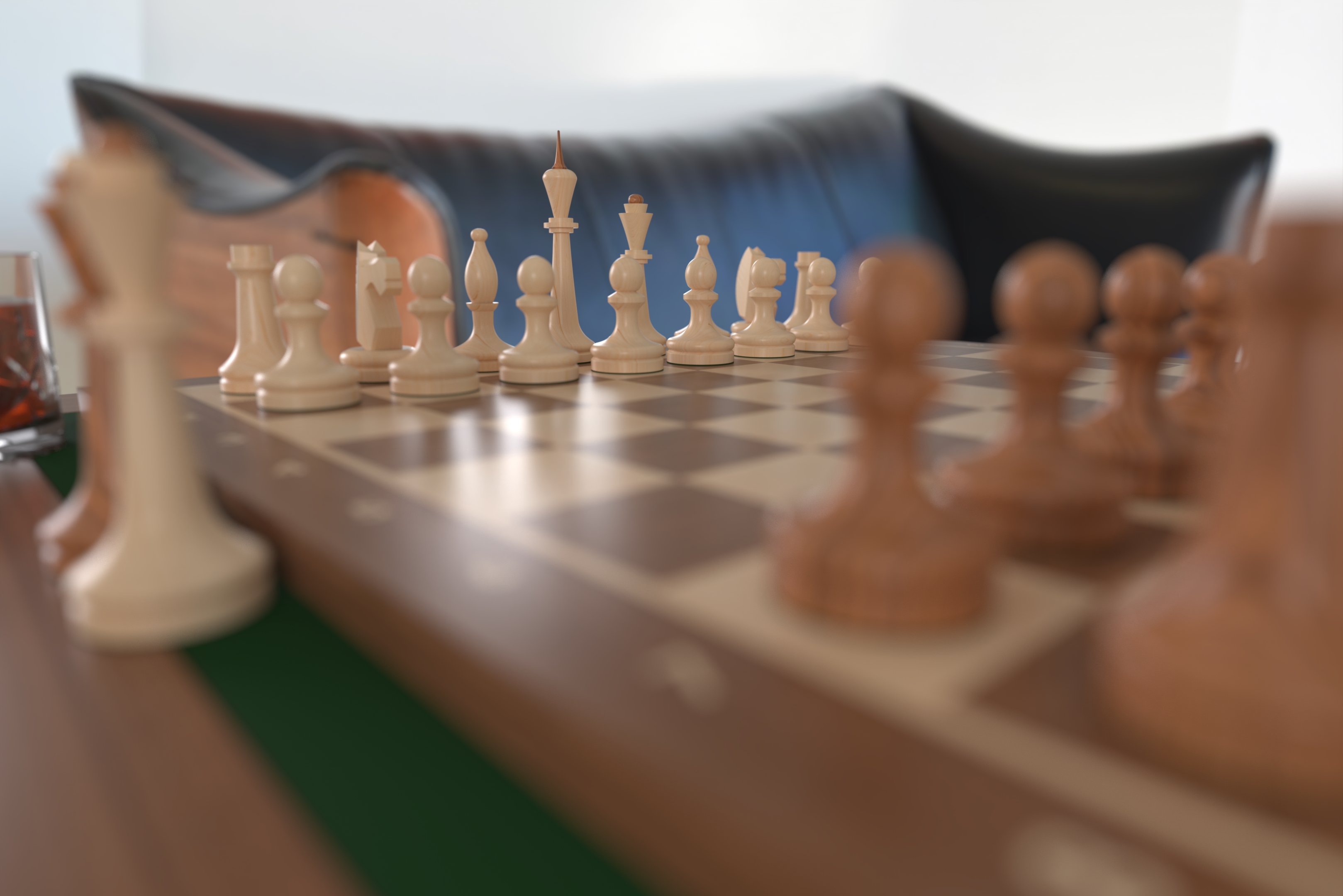
In this, I was deliberate heavy on the Depth of Field, to compliment the “Rule of Thirds” and the blurred light, all aimed to draw your eye to the white pieces.

Although the focus should have been on the dark Rook, centred with the perspective view of the annotations of the Rank & File drawing your eye to the centre of the image, but the reflections & the light, along with the distortions through the glass, and their positions tends to distract the eyes away from the centre of the image.

In this image I’ve used a ultra-widescreen aspect and Depth of Field to concentrate the view to all of the white pieces.
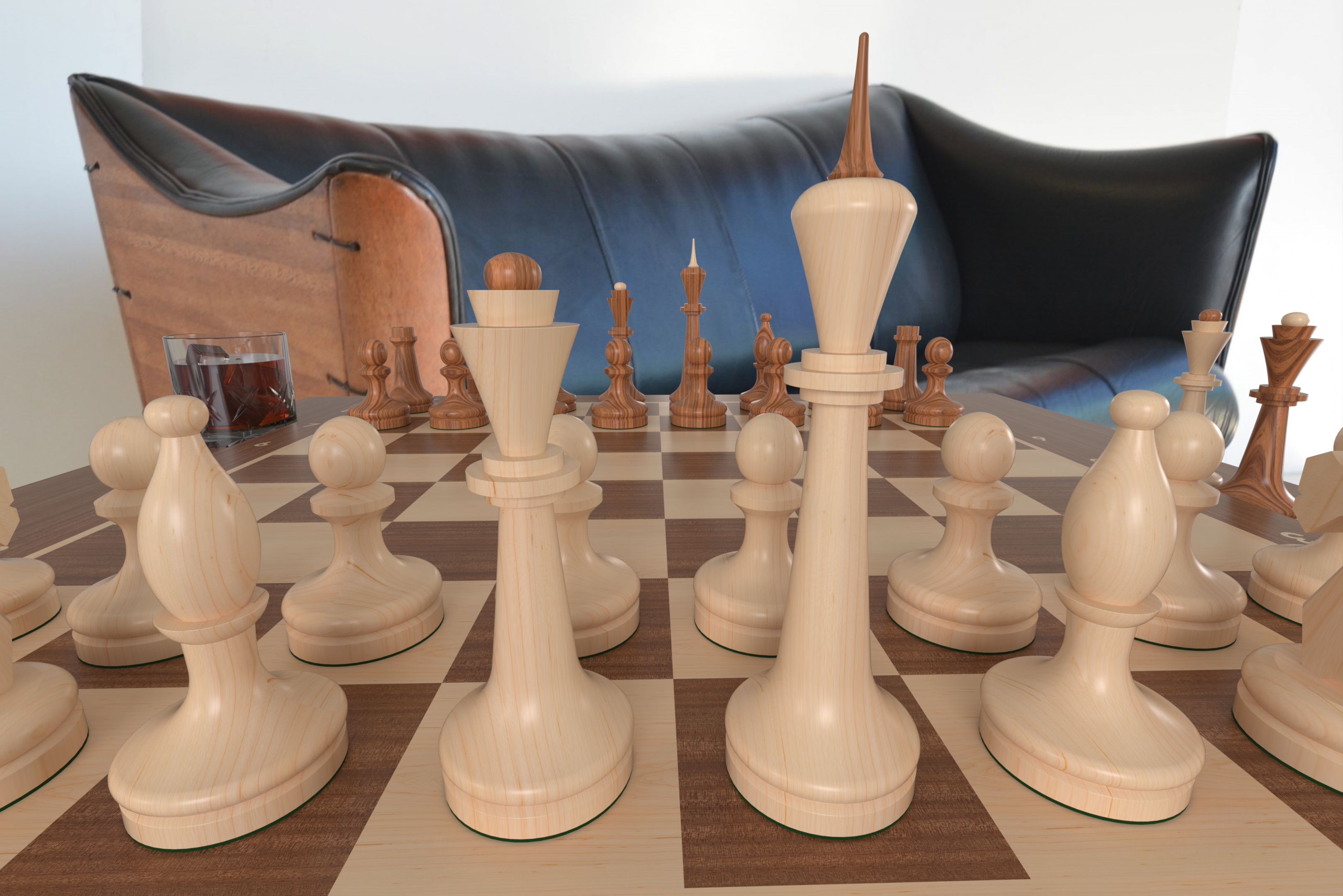
In this I have pushed the over-perspective camera angle to try and highlight the white King & Queen with the aim to align the eye down the perspective centre of the image towards the “framed” dark King & Queen in the distance
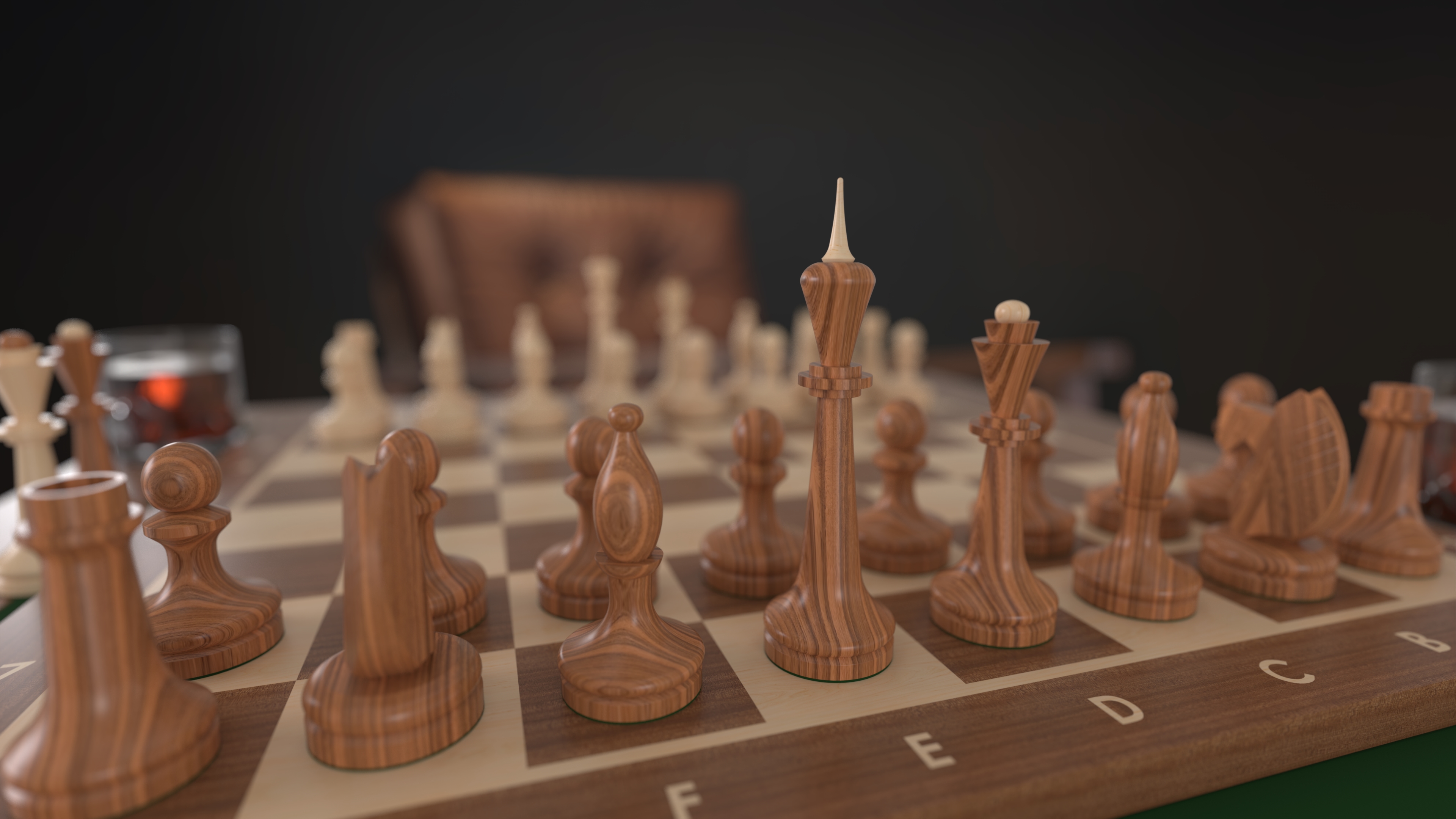
In this, I have used a dark backplate & Depth of Field to concentrates the view to the centre three dark pieces. The reflected light in the glass assists to create almost a “Rule of Thirds” aspect to the image, despite the focus being in the centre of the image.
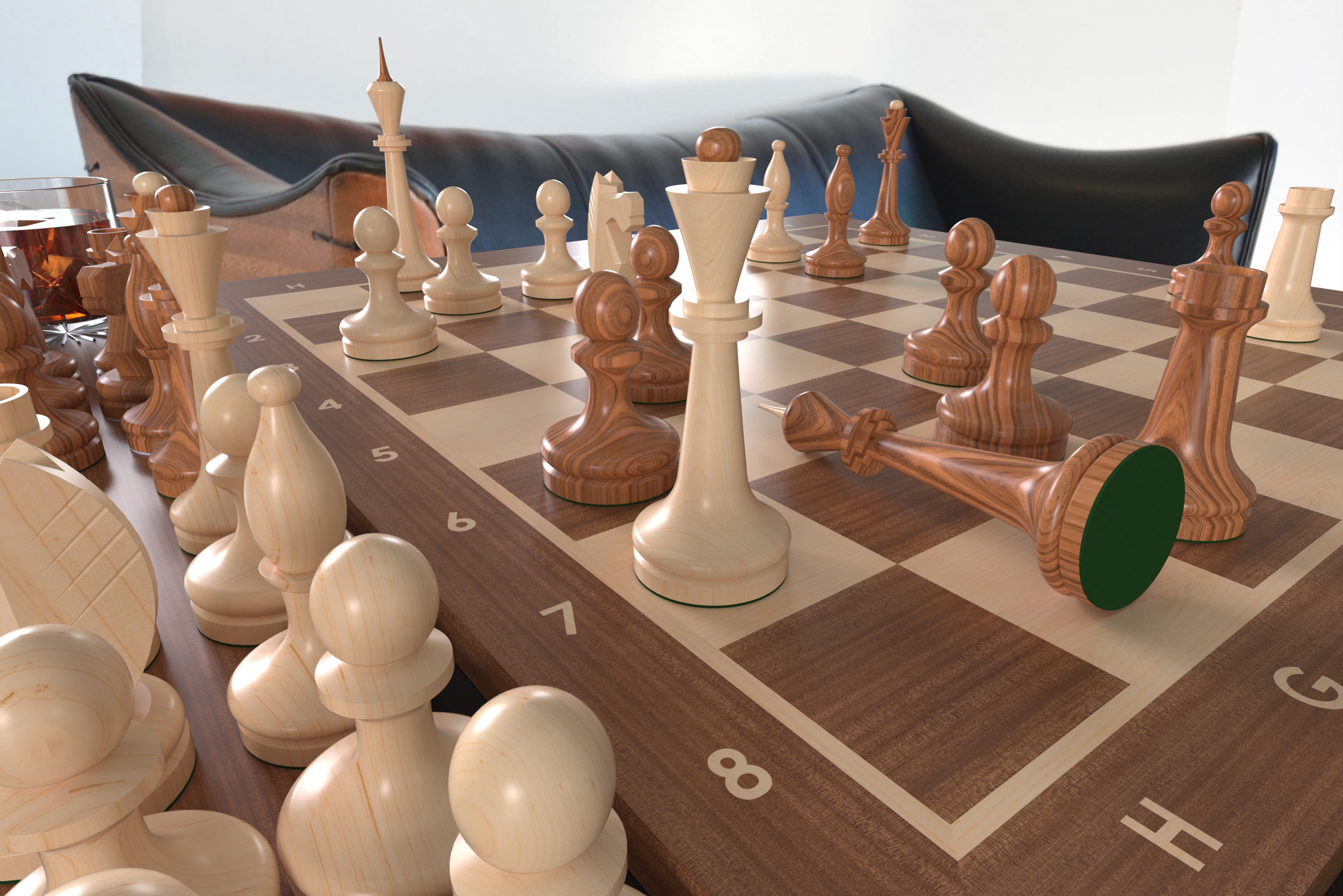
In this the over-perspective camera angle, along and the halo effect of the light, around the white Queen, and along with the reflective light highlights on the dark pieces, all draw the attention to the centred Queen and the fallen dark King.
This was a most enjoyable personal project, which has allowed me to reflect a little of my life’s journey and how having passions in all aspects of your business & personal life should be something to pursue and enjoy!
 Michael Lord
Leave a comment